What the River Remembers: Landscape Art and the Grief We're Finally Learning to Name
I grew up near a creek that doesn't run the way it used to.
My grandmother used to call it "the loud one" because you could hear it from the back porch in spring. Now it barely murmurs, even after rain. I don't think I had a word for what I felt the last time I visited — that specific ache of watching something diminish — until I walked into a gallery in Philadelphia two years ago and saw a painting that named it for me.
The canvas was maybe four feet wide. A wetland scene, rendered in muted greens and silted browns, the water low and the reeds bent at odd angles. In the corner, almost hidden, a faded waterline on a tree trunk marked where the water used to reach. It wasn't a dramatic painting. It didn't shout. But standing there, something cracked open in my chest.
This, I've come to understand, is what contemporary landscape art is doing at its most essential: it's giving us a place to put feelings we don't have names for yet.
The New American Landscape Isn't Pretty — And That's the Point
For most of art history, landscape painting in America operated under a kind of gorgeous lie. The Hudson River School gave us sweeping vistas of Edenic wilderness — light-drenched and sublime, nature as proof of divine promise. It was beautiful, and it was also, in many ways, propaganda. A story the young country told itself about what it had inherited and what it could keep forever.
Contemporary landscape artists are doing something fundamentally different. They're painting the same rivers, the same wetlands, the same coastlines — but with the full knowledge of what's happening to them. The result is a body of work that feels less like celebration and more like witness.
Artist and painter Solène Marsh, whose work has been exhibited at galleries in Santa Fe, Seattle, and most recently at the Milwaukee Art Museum, describes her practice as "environmental portraiture." She paints landscapes the way another painter might paint a dying relative — with tenderness, with unflinching attention, with love that doesn't look away.
"I'm not interested in painting idealized nature," she says. "I want to paint what's actually there. The algae bloom. The low water. The dead trees standing in what used to be a healthy forest. Because if we can't look at it, we can't grieve it. And if we can't grieve it, I don't think we can protect what's left."
Rivers as Memory, Boundaries as Loss
There's a reason rivers keep showing up in this work. Culturally, they've always been our metaphors for time, for passage, for the irreversible. You can't step in the same river twice — that's Heraclitus, but it's also just Tuesday in a changing climate.
For environmental artists working today, rivers carry a particular weight. They're among the most measurable markers of ecological change: their levels, their temperatures, their chemical compositions tell stories that are harder to ignore than abstract statistics. When a painter renders a shrunken river, the viewer doesn't need a science degree to feel something is wrong. The image does the work that data can't.
Photographer and mixed-media artist Jerome Attwater has spent the last five years documenting the Colorado River's diminishing flow, then translating those photographs into large-scale painted collages. His series Diminishing Returns layers painted river scenes over maps, over water rights documents, over old postcards of the river in flood. The effect is something like flipping through a family photo album and realizing the person in every picture is gone.
"I want people to feel the before and after simultaneously," Attwater explains. "Not just to understand intellectually that the river has changed, but to hold both versions at once and feel the distance between them. That distance is grief. That's what I'm painting."
Ecological Loss and the Art of Collective Mourning
There's a relatively new term in psychology — solastalgia — coined by philosopher Glenn Albrecht to describe the grief people feel when their home environment changes around them. It's the distress of watching a familiar landscape become unfamiliar, of losing a place without physically leaving it.
For a long time, this kind of feeling existed without cultural scaffolding. There were no rituals for it, no shared language, no designated spaces to process it together. Contemporary environmental art is quietly building that infrastructure.
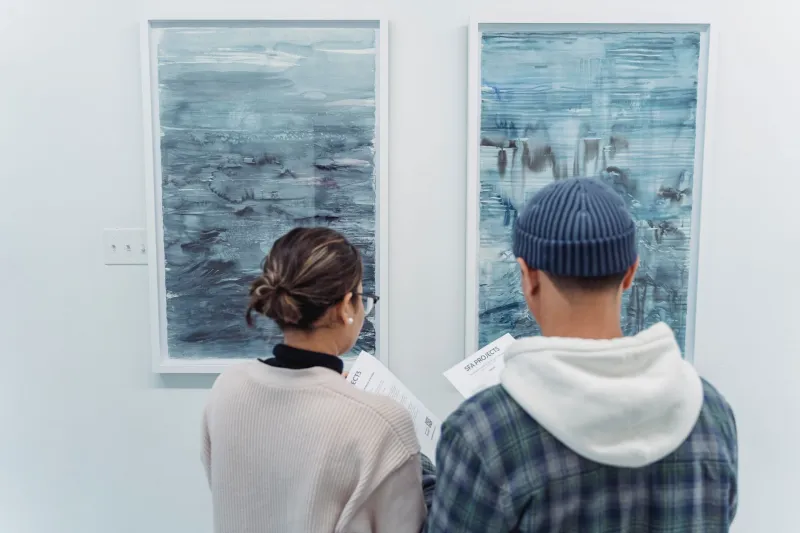
Exhibitions like Watershed at the Smithsonian American Art Museum and Flood Lines at the High Museum in Atlanta have drawn surprisingly diverse audiences — not just art crowds, but farmers, fishermen, climate scientists, teachers. People who spend their lives watching the land and the water, who carry this grief professionally and personally, and who find something in these rooms that functions almost like a church: a shared acknowledgment that what we're losing is real, and that it matters.
"Art creates permission," says Dr. Yolanda Ferris, an environmental psychologist at the University of Michigan who has studied audience responses to climate-themed art. "When we see our private grief reflected publicly — in a gallery, on a canvas, on a scale that required someone's full attention and labor — we understand that our feelings are legitimate. That's not a small thing. That's actually how cultures begin to move."
The Poetics of Wetlands and What Lives at the Edge
If rivers are about time, wetlands are about liminality — those in-between places that belong fully to neither land nor water. They're among the most biologically rich ecosystems on Earth, and among the most threatened. They're also, increasingly, showing up in contemporary art as a kind of central metaphor.
Wetlands hold things. They filter, they absorb, they store carbon and memory in equal measure. When artists paint them — as painters like Erin Genia and Tavita Faleolo have been doing in recent years, often drawing on Indigenous relationships to these landscapes — they're painting places that do the slow, invisible work of keeping other things alive.
There's a lesson in that for how we might think about art's role in this moment. It doesn't solve the crisis. It doesn't replace policy or activism or science. But it does the quiet, essential work of keeping us connected to what we might otherwise disconnect from out of sheer overwhelm.
Holding the Loss Together
At Rivernana, we named ourselves after the river — that image of flowing, of memory carried forward, of something that shapes the landscape it moves through. It feels right that the most urgent art conversation we're having right now is about rivers and wetlands and the boundaries between what was and what is becoming.
This work isn't hopeless, even when it's heartbreaking. The artists making it aren't surrendering — they're insisting that these places are worth grieving, which means insisting they were worth loving. And love, even complicated by loss, is a beginning.
Stand in front of one of these paintings long enough, and you might feel it: that particular ache that is also, somehow, a kind of care. That's the river speaking. It's worth learning to listen.