Grandmother's Hands: The Young Artists Reclaiming Old Craft as Radical Practice
My grandmother never called herself an artist. She called herself practical. She dyed fabric with walnut husks because that's what you did when you needed brown and couldn't afford the store. She braided rugs from worn-out coats because waste was a kind of sin. She put up forty jars of tomatoes every August like it was a sacred obligation, which, in her household, it basically was.
She would have been baffled—and maybe a little tickled—to learn that what she did with her hands has become, for a generation of young American artists, one of the most meaningful and politically charged creative practices of our time.
The Return Nobody Saw Coming
If you'd asked a design critic in 2010 what the next decade of American art would look like, they probably wouldn't have said: natural dyes, sourdough fermentation, and hand-woven baskets. Yet here we are. Across the country, in cities and small towns alike, a growing wave of artists—many of them in their twenties and thirties—are learning the old ways from the people who still carry them. And they're doing it with the kind of intentionality that transforms a skill into a statement.
This isn't a Pinterest trend, though it sometimes gets mistaken for one. The difference is in the depth of engagement. These practitioners aren't following tutorials for aesthetic effect. They're sitting with grandmothers and aunties and community elders for hours, learning not just technique but the stories embedded in technique. The why beneath the how.
Craft as Cultural Reclamation
For many artists of color, returning to traditional crafts is inseparable from questions of cultural survival. African American quilting traditions, for instance, carry centuries of coded history—patterns that may have guided freedom seekers on the Underground Railroad, community practices that were dismissed as domestic labor rather than celebrated as art. When young Black artists today sit down to piece a quilt, they're doing something more than making a beautiful object. They're claiming a lineage.
The same is true in Latinx communities, where bordado embroidery and huipil weaving connect practitioners to pre-colonial textile traditions that survived colonization through the stubbornness of grandmothers who kept stitching. In Indigenous communities across the Southwest and the Pacific Northwest, the resurgence of traditional basket weaving and natural dyeing is explicitly tied to language revitalization, land rights, and the ongoing project of cultural continuity.
"When I learned to weave from my grandmother, I wasn't just learning a skill," one practitioner working in the Pueblo tradition explained at a recent craft symposium. "I was learning how to see. How to see the land, the plants, the seasons. The basket is just where that seeing ends up."
The Politics of Slow Making
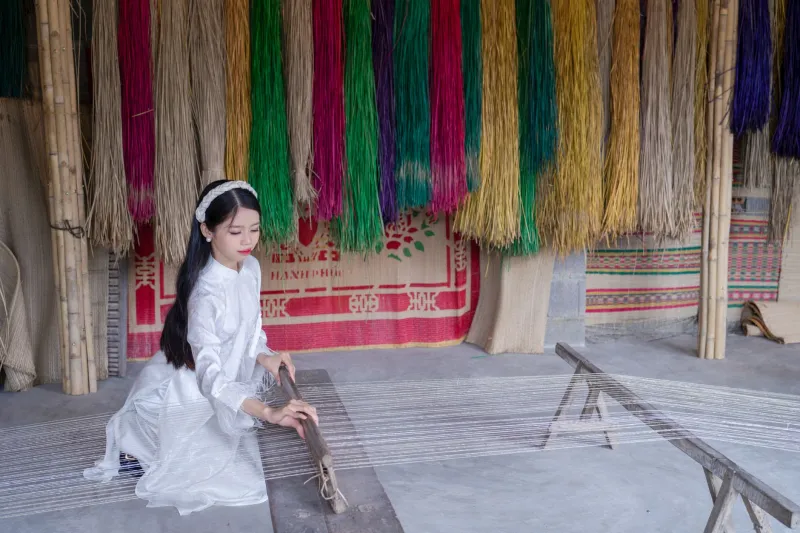
There's something inherently defiant about making things slowly in a world optimized for speed. Natural dyeing—using plants, roots, bark, and minerals to color fiber—can take days or weeks to produce a single hue. Basketweaving requires gathering and preparing materials over months, learning which grasses are ready to harvest and when. Fermentation demands patience that our culture has largely forgotten how to practice.
Artists who work this way are making an argument with their hands. They're saying: not everything worth having can be produced at scale. Not everything worth knowing can be downloaded. Some knowledge lives in the body, transmitted through touch and repetition and the particular smell of indigo in a dye pot.
In an era of mass production and algorithmic aesthetics, this is a genuinely radical position. It refuses the logic of efficiency. It insists that the time spent making something—the hours, the failed attempts, the conversations that happen while your hands are busy—is part of the work's meaning, not just a means to an end.
Learning from Elders as Artistic Practice
What's particularly moving about this movement is the way it reframes the relationship between generations. In a culture that tends to fetishize the new and the young, these artists are positioning themselves as students. They're going to the people who are oldest, who have the most experience, and saying: teach me. What you know matters. What you carry is worth carrying forward.
This is itself a creative act. The artist who spends a summer learning natural dyeing from a 78-year-old Cherokee dye practitioner isn't just acquiring a technique. They're creating a relationship, a record, a thread of continuity. They're ensuring that knowledge doesn't die with a single person.
And the elders, often, are hungry for it. There's a particular kind of grief that comes from holding knowledge that no one seems to want. When someone young shows up and asks to learn—really learn, not just watch a demonstration—it can feel like a kind of rescue.
What Gets Made, and What It Means
The objects that emerge from these practices carry all of this history and intention with them. A naturally dyed textile isn't just beautiful—it's a record of a specific place (what plants grow there?), a specific season (when were they harvested?), a specific relationship (who taught you?). It's irreproducible in a way that digitally printed fabric simply isn't.
Galleries are starting to recognize this. Craft has long occupied a second-class status in the art world, dismissed as decorative or domestic. But the work being made now—conceptually rigorous, politically aware, technically extraordinary—is forcing a reckoning with those hierarchies. The question isn't whether a basket can be fine art. It's why we ever decided it couldn't.
The Grandmother's Legacy
My grandmother's rugs are still on my mother's floor. They're worn in the middle, soft from decades of feet. They were made from coats I never knew, by hands that are gone now. Every time I look at them, I feel something I don't have a good word for—something between grief and gratitude and a fierce desire to learn how to do what she did.
I think that feeling is exactly what's driving this movement. Not nostalgia, exactly. Something more urgent than that. A sense that we've been moving too fast, discarding too much, and that somewhere in our grandmothers' hands is a knowledge we can't afford to lose.
The artists reclaiming these practices aren't looking backward. They're looking for something to stand on. A foundation sturdy enough to build something new.