Built for Quiet: The Architects Turning Silence Into Sacred Space
There's a moment — if you're lucky enough to find it — when the world just stops. Not pauses. Stops. No traffic bleed through the walls, no HVAC hum living behind your thoughts, no distant conversation leaking under a door. Just the soft, almost tangible presence of nothing.
Most of us stumble into that kind of silence by accident. A few architects are building it on purpose.
Across the country, a growing community of designers, sound artists, and spatial thinkers are treating quiet not as the absence of something, but as a material in its own right — something to be sourced, protected, shaped, and delivered. In an era when the average American spends most of their waking hours surrounded by noise levels that researchers link to chronic stress, cardiovascular strain, and cognitive fatigue, silence has quietly become one of the most radical things a building can offer.
The Physics of Hush
Acoustic design has existed as a discipline for over a century, but its ambitions have shifted. Early concert hall engineers were obsessed with projection — how to make a violin carry to the back row. Today's most interesting practitioners are asking the opposite question: how do you make sound disappear?
It's not a simple problem. Sound is physical. It travels through air, yes, but also through concrete, through steel, through the bones of a building. A wall that looks solid to the eye is often acoustically porous — vibrating in sympathy with the noise on the other side. Truly quiet spaces require what designers call "decoupling" — floating floors, suspended ceilings, walls that don't actually touch the structure they appear to be part of. It's architecture that hides its own seams.
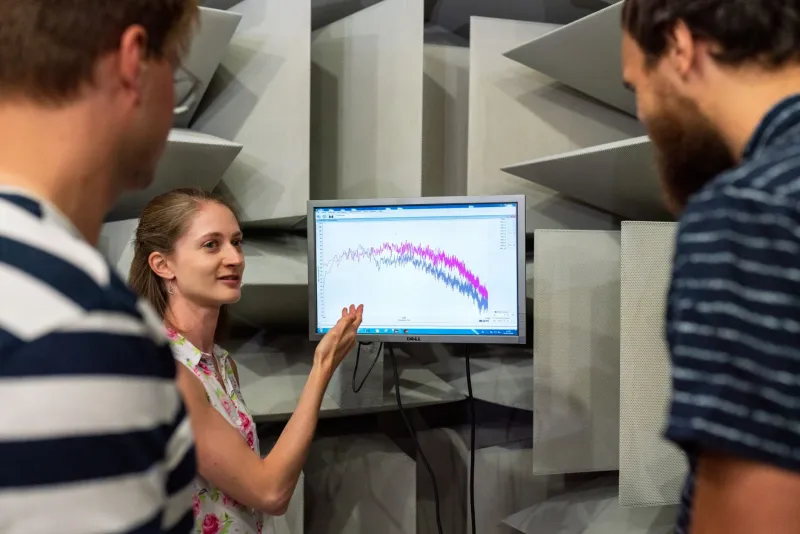
Some of the most extreme examples are anechoic chambers — rooms lined with foam wedges that absorb nearly all reflected sound, reducing ambient noise to levels below what humans can typically perceive. Microsoft's anechoic chamber in Redmond, Washington once held the Guinness record for the quietest place on earth, registering at negative 20.6 decibels. Most people can only tolerate about 45 minutes inside before the silence itself becomes overwhelming — the body, deprived of external sound, begins to hear itself: heartbeat, digestion, the faint electrical hum of the nervous system.
But the goal isn't sensory deprivation. It's something more livable than that.
Meditation Rooms and the New Architecture of Stillness
In cities like New York, Chicago, and Los Angeles, meditation centers and wellness spaces have become unlikely laboratories for acoustic experimentation. Designers working in this space talk about "acoustic comfort" — a condition where the sonic environment supports the body's natural tendency toward calm rather than working against it.
This involves more than just adding insulation. It means thinking about reverberation time (how long a sound lingers after it's made), about the frequency of ambient noise (low rumbles are processed differently than high-pitched whines), and about the psychological relationship between space and sound expectation. A high ceiling in a stone room signals to the brain: expect echo. A low ceiling with soft materials says: this is a place to whisper.
Some designers are going further, using what's called "acoustic landscaping" — introducing carefully controlled, low-level natural sounds like running water or rustling leaves to mask unpredictable urban noise. The goal isn't total silence so much as sonic sovereignty: giving a person control over what they hear, rather than leaving them at the mercy of the city.
Concert Halls That Listen Back
Paradoxically, some of the most acoustically sophisticated spaces in America aren't meditation rooms — they're concert halls. The renovation of David Geffen Hall at Lincoln Center in New York, completed in 2022, involved a near-total interior rebuild guided partly by acoustic science and partly by something closer to artistic intuition. The hall was reimagined not just to project sound outward but to create what the designers described as an "enveloping" experience — where audience members feel held by sound rather than merely aimed at by it.
That shift in language is telling. "Held" is a word that belongs to comfort, to safety, to the body. Acoustic design, at its most thoughtful, is starting to sound less like engineering and more like care.
The same instinct is showing up in smaller, less celebrated spaces. Libraries are redesigning reading rooms with sound-absorbing canopies that hover above the stacks like low clouds. Airport terminals — historically among the most acoustically hostile environments imaginable — are beginning to incorporate quiet zones with material choices that dampen the chaos just enough to let a traveler breathe. Even some tech campuses in California have started commissioning "silence rooms" as seriously as they once commissioned ping-pong tables, recognizing that genuine cognitive rest requires an environment that stops asking something of you.
What Silence Actually Costs
None of this comes cheap, and that's worth sitting with for a moment. The communities most exposed to chronic noise pollution in the United States — neighborhoods near highways, flight paths, and industrial corridors — are disproportionately low-income communities and communities of color. The luxury of quiet, in many American cities, maps almost perfectly onto the geography of privilege.
That's a design failure as much as a policy one. Some architects and urban planners are beginning to push back, advocating for acoustic equity as a genuine public health framework — arguing that access to quiet should be treated with the same seriousness as access to clean air or green space. A few cities have begun integrating acoustic impact assessments into zoning decisions, though the practice remains far from standard.
The most idealistic voices in this conversation imagine a future where quiet is understood as infrastructure — something a city provides, maintains, and distributes with intention. Where a neighborhood park isn't just a patch of green but a designed acoustic refuge, shaped to give residents a few minutes of something the built environment almost never offers them: the chance to hear themselves think.
Learning to Listen to Nothing
There's something almost countercultural about all of this. We live in a moment that rewards loudness — loud opinions, loud aesthetics, loud notifications. Silence can feel like surrender, or worse, irrelevance. And yet the architects and designers working in this space seem motivated by something quietly urgent, a conviction that what we build shapes not just how we move but how we feel, how we recover, who we get to be when no one is asking anything of us.
Building for silence is, in that sense, a kind of editorial act. It says: this matters. This rare, difficult, increasingly scarce thing — the sound of nothing — is worth protecting. Worth engineering. Worth the cost of a floating floor and a decoupled wall and a ceiling that swallows echo like still water.
Some spaces, it turns out, are most powerful when they ask nothing of your ears. When they just let you arrive.