Clay, Thread, and Iron: Why Making Things by Hand Feels Like an Act of Resistance
Let me tell you about a waiting list.
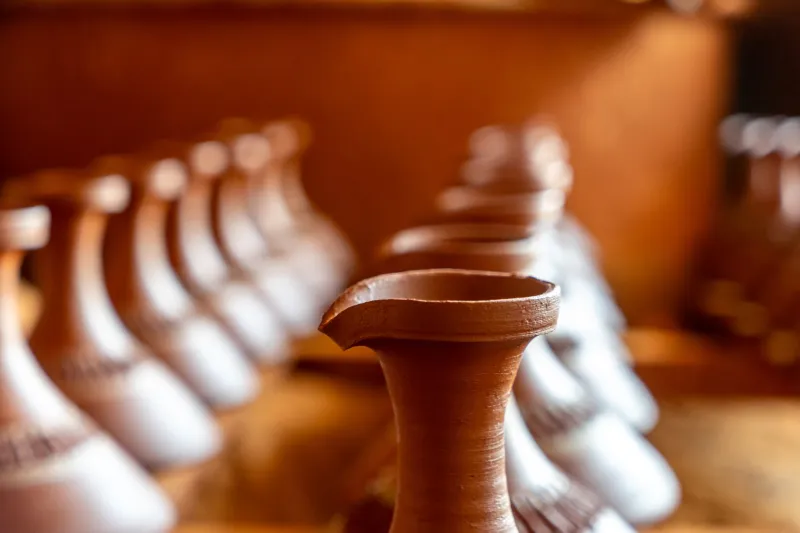
Not for concert tickets. Not for a restaurant reservation or a limited sneaker drop. A waiting list for hand-thrown ceramic mugs made by a single potter working out of a converted garage in Asheville, North Carolina. Months long. Hundreds of names. People who have never met this maker, who found her through a single Instagram video of wet clay collapsing and reforming under patient hands, and decided — with a certainty that probably surprised them — that they needed to own something she made.
This is the quiet revolution nobody fully has a name for yet.
The Return of the Irreplaceable
We live inside an economy of abundance and frictionlessness. You can have almost anything delivered to your door by tomorrow. Algorithms anticipate your preferences before you've fully formed them. Objects are optimized, mass-produced, and priced for disposability. And yet — here we are, crowdfunding hand-forged kitchen knives and signing up for eight-week natural dyeing workshops and paying three times the market rate for a blanket woven on a floor loom by someone whose name we actually know.
The resurgence of pre-industrial craft practices — ceramics, weaving, blacksmithing, bookbinding, natural dyeing, hand-papermaking — is one of the genuinely interesting cultural phenomena of our moment. And it's worth sitting with the why before rushing to explain it away as aesthetics or trend-cycling.
Because this doesn't feel like a trend. It feels like a hunger.
What the Algorithm Can't Give You
Here's what a handmade object offers that no digital experience can replicate: evidence. Evidence that time passed. That hands moved. That a specific human being, with their particular set of skills and limitations and decisions, made something that now exists in the physical world and will outlast the moment of its making.
A thrown pot has a bottom that's slightly thicker on one side. A woven textile holds the tension of the weaver's hands in its selvedge. A hand-forged piece of iron carries the marks of hammer strikes that couldn't be precisely repeated. These imperfections aren't flaws to be corrected — they're the signature of presence. They're proof that something real happened.
In a world where so much of what we consume is generated, optimized, or assembled by processes invisible to us, that proof matters more than we might have expected.
The Makers Themselves
Spend any time in the contemporary craft world and you'll notice something about the people leading this resurgence: they're not uniformly who you might picture. Yes, there are plenty of white women with farmhouse aesthetics building pottery followings on social media. But there are also Black metalworkers reclaiming ironworking traditions with deep roots in African and African American history. There are Indigenous weavers asserting cultural sovereignty through textile practice. There are queer ceramicists making work that is explicitly political, explicitly bodily, explicitly about what it means to occupy a physical form in a world that increasingly wants to abstract us into data.
The craft revival, at its most interesting edges, is not about cottagecore escapism. It's about who gets to make things, whose making gets valued, and what it means to insist on the primacy of the physical in a culture that keeps trying to convince us we can live entirely in the cloud.
Blacksmiths like Darrius Douce are building practices that connect the hammer and anvil to the history of enslaved African American metalworkers whose skills were essential to the American economy and systematically unacknowledged. Weavers working in Navajo and other Indigenous traditions are pushing back against the mass reproduction of their designs, insisting that craft is not just technique but relationship — to land, to community, to a way of knowing the world.
This is what radical making looks like.
Slowness as a Design Principle
From a design perspective, the craft revival is doing something genuinely interesting: it's reintroducing slowness as a value. Not inefficiency — slowness. The difference matters.
Modern design culture has been obsessed with iteration speed, rapid prototyping, the ability to pivot and scale. These are real virtues in certain contexts. But they've also produced a visual and material landscape that often feels thin — beautiful on a screen, forgettable in person, gone by next season.
Craft operates on a different clock. A weaver working on a complex tapestry might spend weeks on a single piece. A blacksmith shaping a tool by hand is in conversation with material and time in a way that no CNC machine can replicate. The slowness isn't incidental to the quality of what's made — it's constitutive of it. You can't rush a thing into depth.
Designers who understand this are increasingly incorporating craft knowledge into contemporary practice — not as decoration, but as a way of thinking about materiality, durability, and the relationship between maker and user. The best work coming out of studios right now often feels like a conversation between old knowledge and new questions.
The Meditation Nobody Advertised
There's another thing happening in the craft revival that doesn't get talked about enough: it's functioning as a form of mental health practice for a lot of people.
Not in a commodified wellness-industry way, though that framing exists too. But genuinely — the repetitive, embodied, attention-demanding nature of handwork offers something that meditation apps and therapy (both valuable in their own right) can't quite replicate. It puts you in your body. It makes you pay attention to something outside your own thought loop. It produces a tangible result from sustained effort, which turns out to be deeply satisfying to a brain that spends most of its time managing intangible, unresolvable problems.
People are taking ceramics classes not primarily to become potters, but because throwing clay is one of the few activities that makes their phone feel genuinely irrelevant for an hour.
That's not nothing. That might actually be everything.
The Object That Stays
What we're really talking about, underneath all of it, is the desire for objects that mean something. Not in a sentimental, kitschy way — in a real way. Objects that carry the trace of their making. Objects that were chosen rather than defaulted to. Objects that will still be here in twenty years, that might be handed down, that exist in three dimensions and can be held and used and broken and repaired.
In an era of digital ephemerality — where the platforms that host our memories can disappear, where the content we create can be deleted or deplatformed, where so much of what we call culture lives on servers we don't own — there's something genuinely countercultural about insisting on the permanence of the made object.
The ceramicist in her garage. The weaver at her loom. The blacksmith at the forge. They're not opting out of the present. They're offering a different version of it — one where things take time, where hands matter, where the object that emerges carries the full weight of its own making.
That's not nostalgia. That's a proposal for how to live.