Earth, Ground, Memory: The Artists Keeping America's Ancient Colors Alive
The blue that once colored the fabric of the American South wasn't a formula. It wasn't manufactured in a factory in New Jersey or mixed from a tube imported from abroad. It came from a plant — Indigofera tinctoria — grown in the tidal lowlands of South Carolina and Georgia, processed by enslaved hands through labor so demanding and knowledge so precise that the expertise required generations to develop and mere decades to nearly disappear.
That blue has a different weight than the blue in a paint store. It has a different smell, a different depth, a different relationship to the light that falls on it. And for a growing community of artists, dye workers, and cultural preservationists across the United States, recovering it — and colors like it — has become something close to a calling.
Color as Geography
Before global supply chains and synthetic dyes, color was local. The pigments available to an artist or craftsperson in the American Southwest were fundamentally different from those available in the Pacific Northwest or the Appalachian highlands. This wasn't a limitation. It was a vocabulary — a set of visual frequencies tied to specific soils, specific plants, specific mineral deposits, specific bodies of water.
You can still see this in the art of communities that never fully surrendered these practices. Pueblo pottery from New Mexico carries the ochres and terra cottas of the Colorado Plateau. Navajo textiles shimmer with colors derived from native plants that grow at specific elevations in specific seasons. Gullah Geechee indigo work along the South Carolina coast carries the memory of an entire agricultural system — and the human cost of building it.
These aren't merely aesthetic choices. They're acts of geographic and cultural specificity. They say: this thing was made here, by these hands, from this earth.
The Revivalists
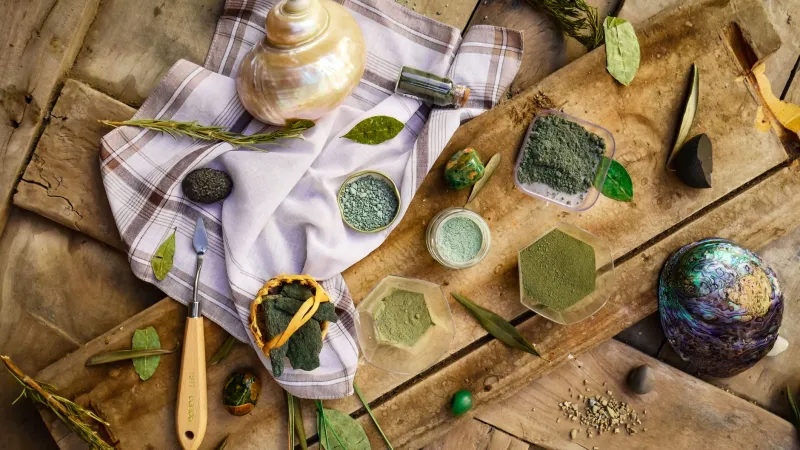
In a studio in Albuquerque, a painter named Elena Runningwater grinds ochre from stone she collects herself in the high desert north of the city. The process takes hours. The color it produces — a warm, complex amber that shifts from gold to rust depending on the light — cannot be replicated from a tube.
"When I use a commercial pigment, I'm using a color that's been standardized," she says, her hands moving steadily over a grinding stone worn smooth with use. "It's the same whether you're in New Mexico or New York. When I use this, I'm using a color that only exists because of this specific landscape. The painting knows the difference, even if the viewer doesn't."
Runningwater is part of a loose network of practitioners across the country who are researching, reviving, and teaching traditional pigment-making practices rooted in specific American regions. Some come from the communities whose traditions they're working with. Others are researchers, artists, and craftspeople who've arrived at the work through different paths but share a conviction that the industrialization of color has cost us something worth recovering.
In South Carolina, a textile artist named Dara Okonkwo has spent the past several years working with historians, botanists, and Gullah Geechee community members to revive indigo cultivation and processing in the region where it once flourished. The work is slow, painstaking, and deliberately communal — a practice that insists on its own context.
"Indigo from this soil isn't just a color," she says. "It's a whole story. The people who developed this knowledge, the people who were forced to use it, the people who've been trying to reclaim it. You can't separate the blue from any of that."
What's at Stake
The urgency behind this work isn't purely nostalgic. As the last generation of practitioners who learned these methods in living tradition ages, the knowledge risks disappearing not just from practice but from memory. Oral traditions, embodied techniques, and material knowledge tied to specific landscapes don't survive well in digital archives. They survive in hands.
This is why so many of the revivalists are also teachers — running workshops, collaborating with tribal colleges and cultural centers, documenting processes on video not for broad consumption but for community transmission. The goal isn't to produce a museum-worthy reconstruction. It's to keep the knowledge moving through living people.
In the Pacific Northwest, members of several Coast Salish communities have been working to recover the production of black pigment from a specific species of lichen that grows in old-growth forests — a material used in ceremonial art for generations, now threatened both by deforestation and by the interruption of the knowledge chain. The effort involves ecologists, elders, and young artists learning to identify, harvest, and process the material according to protocols that are cultural as well as technical.
"The color is connected to the forest," explains one artist involved in the project, who asked that her name not be published. "If the forest goes, the color goes. If the knowledge goes, the color goes even if the forest is still there. We're trying to make sure neither of those things happens."
The Aesthetics of Place
There's a design argument to be made here as well, beyond the cultural and ecological ones. In an era of algorithmic aesthetics — where color trends are set by data analysis and spread globally within months — art that insists on regional specificity offers something genuinely different to the eye.
The colors produced by traditional pigment practices have a quality that's difficult to articulate but unmistakable to experience. They're less uniform. They have what some practitioners call body — a depth and variation that synthetic pigments, however sophisticated, tend to flatten. They age differently. They interact with natural light in ways that feel somehow more alive.
This isn't sentimentality. It's material reality. And it's one reason why a growing number of contemporary artists — not all of them working from within traditional communities — are incorporating regional and natural pigments into work that is unmistakably of the present.
The Color That Carries Memory
There's a phrase that comes up again and again in conversations with the people doing this work: color memory. The idea that certain colors carry embedded cultural information — that the specific blue of South Carolina indigo, or the ochre of New Mexico sandstone, or the black of a Pacific Northwest lichen activates something in the people who have ancestral relationships with those materials and those landscapes.
This is not mysticism. It's the recognition that culture is material — that the things we make from the earth carry the earth's identity back into the world. When those materials are replaced by universal substitutes, something specific and irreplaceable is lost.
The revivalists aren't arguing against progress or synthetic chemistry. They're arguing for the preservation of alternatives — for a world in which the color of a painting can still tell you where it came from, what earth it rose from, whose hands it passed through.
That's a small thing, maybe. Or maybe it's enormous. The river knows what it carries, even when it runs clear.