Room to Breathe: How Cultural Spaces Are Being Redesigned for the Quietly Overwhelmed
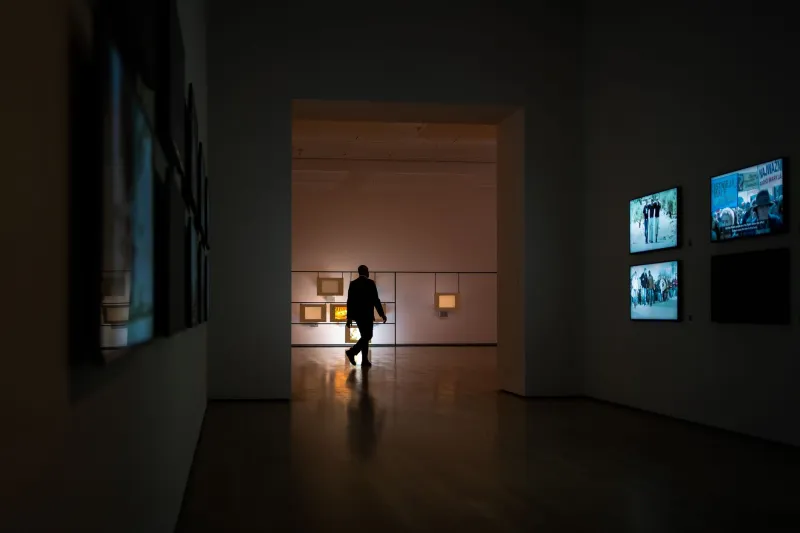
You know the feeling. You've walked through three rooms of a major exhibition, read every label, absorbed every curatorial argument, and somewhere around the fourth gallery you realize you're not really seeing anything anymore. Your eyes are moving but your mind has gone somewhere else entirely—probably to your inbox, or to the low-grade anxiety that's been humming under everything for weeks.
You came to the museum to feel something. Instead, you feel tired.
This is not a personal failure. It is, increasingly, a design problem. And a growing number of curators, architects, and cultural administrators are starting to treat it like one.
The Overstimulation Problem Nobody Wanted to Name
For most of the twentieth century, the dominant philosophy of museum design was more. More objects, more information, more interpretation, more programming. The implicit promise was that a fuller experience was a better experience—that the visitor who left knowing the most had gotten the most value.
But that model was built for a world that no longer quite exists. Contemporary visitors arrive already saturated. They've scrolled through hundreds of images before breakfast. They've consumed more information by noon than a person in 1950 would have encountered in a week. By the time they walk through the museum doors, their attention is not a blank canvas. It's a surface that's already been written on, many times over.
The cultural institutions that are thriving right now are the ones that have understood this shift. Not by dumbing down or speeding up, but by doing something counterintuitive: slowing everything down.
Designing for the Pause
The most thoughtful interventions happening in American museums right now aren't the blockbuster shows or the augmented reality experiences. They're quieter than that. A room with no labels, just one painting and a bench placed at exactly the right distance. A sensory garden between wings where visitors can step outside without leaving the building. A low-stimulation morning, offered once a week, when the lights are dimmed, the audio tours are silenced, and the galleries are opened early to anyone who needs a gentler entry point.
These aren't accommodations in the accessibility sense alone, though they absolutely serve visitors with sensory processing differences, anxiety disorders, and autism spectrum conditions who have historically found museum environments hostile. They're also design statements. They say: rest is part of what we're offering here. Stillness is a valid reason to come.
The Isabella Stewart Gardner Museum in Boston has long been celebrated for its non-traditional approach to display—objects arranged according to Gardner's personal aesthetic vision rather than curatorial convention, with a policy against rearrangement that creates an eerie, intimate sense of time stopped. The Noguchi Museum in Queens, New York, built into the sculptor's former studio, operates with a quietness that feels almost architectural—the spaces themselves seem to ask you to move more slowly.
But newer initiatives are going further, explicitly naming rest and restoration as institutional values.
The Meditation Room and What It Admits
Several major institutions have now introduced designated meditation or reflection rooms within their permanent galleries. The design of these spaces is worth paying attention to, because design is always an argument.
Typically, they're stripped of the visual noise that characterizes exhibition spaces. Soft lighting. Minimal furniture. Perhaps a single work of art, or none at all. Sometimes sound—ambient, unobtrusive, the kind that doesn't ask anything of you. The message encoded in every material choice is the same: you don't have to perform engagement here. You can just be.
That this feels radical says something uncomfortable about how we've designed cultural experience up to now. We've built institutions that implicitly demand productivity from their visitors—learn this, understand that, form an opinion, take a photo to prove you were here. The meditation room is an admission that this demand has costs. And that the museum, as a civic institution, has some responsibility for the wellbeing of the people who walk through its doors.
Architects Thinking About Nervous Systems
The most forward-thinking architects working on cultural spaces right now are explicitly incorporating neuroscience and sensory research into their design process. Natural light that shifts through the day. Acoustic materials that absorb rather than amplify. Circulation paths that offer choices—the option to exit a gallery without passing through more of it, the ability to find a quieter corner without navigating a crowd.
These aren't luxuries. They're recognitions that the body experiences architecture before the mind does. That a visitor who feels physiologically safe and comfortable is capable of a depth of attention that a visitor who is overwhelmed, overlit, or acoustically assaulted simply isn't.
Some institutions are working with occupational therapists and sensory design specialists to audit their spaces in ways they never have before. What does this gallery feel like to someone with heightened auditory sensitivity? What does this entrance communicate to a visitor who is already anxious? The questions are practical, but the implications are philosophical: who is this space actually for?
Slow Looking as a Practice
Parallel to these architectural interventions, a number of museums have developed programming explicitly designed to teach—or perhaps more accurately, to restore—the capacity for sustained attention. Slow art programs, borrowed from the slow food movement's emphasis on presence and intentionality, ask participants to spend thirty or forty minutes with a single work. No phones. No note-taking. Just looking.
The reports from these programs are striking. Participants consistently describe the experience as unexpectedly emotional. Works they would have glanced at for thirty seconds in a normal visit reveal themselves over time as inexhaustibly complex. Small details emerge. Personal associations surface. Something that functions almost like conversation begins to happen between the viewer and the object.
This is what art was always capable of. We just built environments that made it nearly impossible.
What We're Really Talking About
At its deepest level, the movement toward restorative museum design is a conversation about what cultural institutions are for. Are they entertainment venues competing with every other claim on our attention? Are they educational facilities optimizing for information transfer? Or are they something rarer and more essential—spaces set apart from the relentless forward motion of ordinary life, where a different kind of time is possible?
The curators and architects doing this work seem to believe, firmly, that it's the third thing. That the museum's irreplaceable value lies precisely in its capacity to offer what the rest of the world doesn't: permission to stop. To look. To feel something without immediately being asked to share it.
In a culture that has monetized attention and commodified experience at every turn, that permission is not a small thing. It might, in fact, be everything.
So the next time you walk into a gallery and find a bench placed just so, in just enough light, in front of something that asks nothing of you except your presence—sit down. That bench was put there by someone who understood what you needed before you did.