Still Hours: How Young People Are Learning to Sit With Art — and Themselves
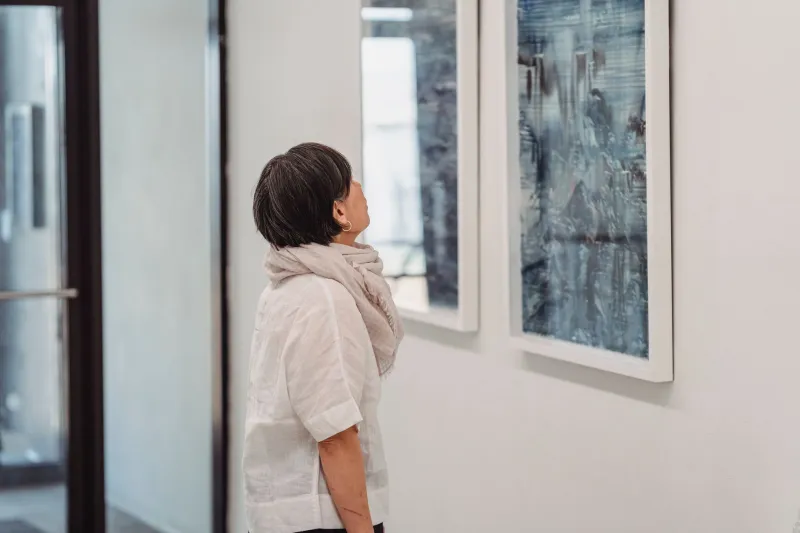
There's a woman in her mid-twenties who visits the Art Institute of Chicago every other Saturday. She doesn't bring headphones. She doesn't consult the audio guide. She picks one room — usually the Impressionists — finds a bench, and sits. Sometimes for two hours. Sometimes more. She's not waiting for someone. She's not killing time. She's doing what she calls, simply, looking.
"People think I'm weird," she laughs. "Like, why are you just sitting there? But that's kind of the point."
She's not alone. Across the country, in museums large and small, something is shifting in how younger visitors engage with art. Call it the slow museum movement — though most of its practitioners wouldn't use that term, or any term at all. They're just showing up, sitting down, and refusing to leave quickly.
The Overcorrection Nobody Expected
For years, cultural institutions worried about Gen Z's relationship with attention. The concern was that younger audiences couldn't — or wouldn't — slow down enough to genuinely engage with art. Galleries responded with Instagram-friendly installations, gamified exhibits, and QR codes linking to TikTok explainers. Some of that worked. Some of it turned museums into content factories.
But a counterwave has been building. Quietly, without manifesto or hashtag, a segment of younger visitors is doing something that looks almost radical in 2025: they're choosing boredom. They're choosing stillness. They're choosing to stay.
Museum staff at institutions like the Whitney in New York and the SFMOMA have begun noticing unusual foot traffic patterns — visitors who linger in single galleries for extended stretches, who return to the same rooms on repeat visits, who seem less interested in covering ground than in going deep. Some institutions are now quietly tracking "dwell time" per gallery as a new metric of meaningful engagement.
"We used to think success was throughput," says one gallery educator at a mid-sized art museum in Philadelphia who asked not to be named. "Now we're asking ourselves whether someone who spends three hours in one room isn't actually our most successful visitor."
What They're Looking For
Ask the young people doing this what draws them to it, and the answers are strikingly consistent: they're tired.
Not physically tired, necessarily — though that too. But tired in a way that's harder to name. Tired of information arriving in fragments. Tired of opinions forming before understanding has a chance to settle. Tired of consuming without absorbing.
"My phone is always asking something of me," says a 22-year-old design student in Atlanta. "Even when I'm relaxing, I'm performing relaxation for an audience. In a museum, nothing wants anything from me. I can just be in front of something beautiful and let it work on me."
That phrase — let it work on me — comes up again and again. There's an almost therapeutic quality to what these visitors describe. Not therapy in a clinical sense, but the older, stranger kind: sitting with something you don't fully understand and trusting that understanding will arrive on its own schedule.
Psychologists who study attention have a term for this kind of engagement: soft fascination. It's the opposite of the directed, task-oriented focus demanded by screens. Soft fascination allows the mind to wander productively — to make unexpected connections, to process emotion sideways, to rest without going blank. Art, it turns out, is exceptionally good at inducing it.
The Bench as Sanctuary
There's something worth noting about the physical experience of the slow museum visit. The bench matters. The quality of light matters. The hush of a gallery where other people are also, somehow, being quiet — that matters enormously.
Several of the young visitors I spoke with described a near-meditative quality to their long sits. One woman in her late twenties who regularly spends Sunday afternoons at the Minneapolis Institute of Art told me she sometimes cries — not from sadness, but from something she can only describe as "release."
"I think I hold a lot of tension in my body from just existing in the world right now," she says. "And there's something about sitting in front of a painting that's been around for four hundred years that puts things in proportion. Like, this thing survived. It's still here. And I'm allowed to just look at it."
That sense of permission — of being allowed to simply look — points to something quietly significant. In a culture that relentlessly monetizes attention and productivity, spending two hours with a single canvas is a small act of refusal. It doesn't produce content. It doesn't generate data. It doesn't optimize anything. It's just a person and a painting, doing the oldest thing in the world.
How Museums Are (Slowly) Responding
Some institutions are beginning to create formal space for this kind of engagement. The concept of "slow looking" programs — structured sessions that invite visitors to spend extended time with a single work — has gained traction in educational departments at several major American museums. These aren't guided tours in the traditional sense. They're more like facilitated sitting, with a curator occasionally offering a question or observation but mostly just holding space.
Others are rethinking their physical environments. Comfortable seating, better acoustics, fewer crowded galleries — the design language of contemplation rather than spectacle. It's a subtle shift, but a meaningful one.
What's interesting is that this isn't being driven by institutions. It's being demanded, quietly, by visitors who've already figured out what they need. The museums are catching up.
The River of Looking
There's a reason we talk about getting lost in a painting, about falling into an image. The metaphors are all about surrender — about letting something carry you rather than directing the current yourself. That's not a passive experience. It's an active one, but the activity is internal.
For a generation that has grown up with the internet's relentless demand for reaction, learning to look without immediately responding is almost a skill that has to be relearned. The slow museum visit is, in that sense, a kind of practice. A discipline disguised as leisure.
And maybe that's exactly what makes it feel so necessary right now. Not as escape, but as return — to curiosity, to patience, to the strange and sustaining pleasure of not knowing what something means yet, and sitting with it anyway.