Written on the Walls: The Secret Conversations Happening Inside America's Galleries
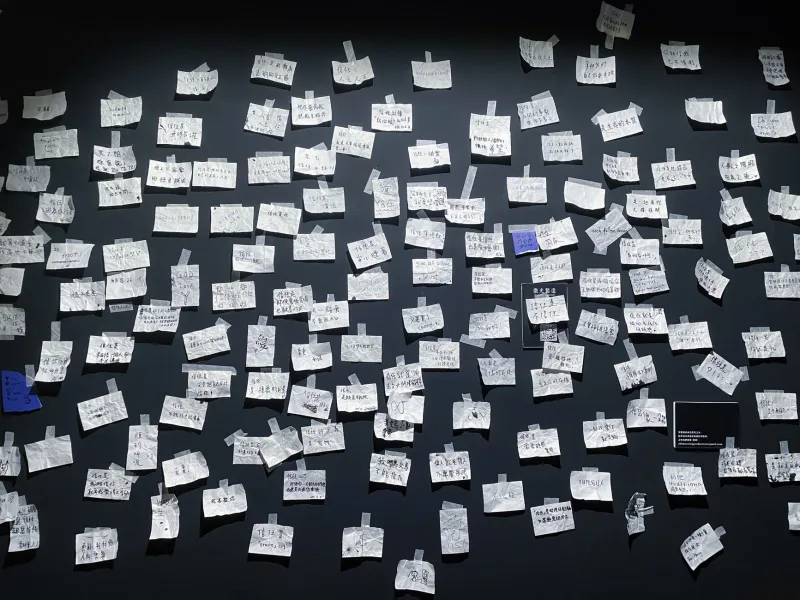
It started, as many strange and beautiful things do, with a Post-it note.
A few years back, a visitor to a gallery in Brooklyn left a small yellow square on the wall beside a painting of a woman looking out a window. On it, in looping blue pen: She's waiting for the same thing I am. I don't know what that is yet.
By the end of the day, three more notes had appeared beside it. By the end of the week, the wall had become something else entirely — a palimpsest of strangers' longing, recognition, and confusion. The gallery eventually took them down. But not before someone had photographed the whole accumulation and posted it, quietly, to a small corner of the internet where people who care about that sort of thing could find it.
The practice has a name now, at least in certain circles: margin noting. And it's more widespread than most museums would like to admit.
The Living Text of Shared Space
The impulse behind margin noting isn't new. Readers have scrawled in the margins of books for centuries — responding, arguing, weeping, questioning. Some of the most intimate records of how humans have engaged with ideas exist in the margins of borrowed library books and worn paperback copies passed between friends. The act of annotation is fundamentally relational: it says I was here, I felt this, I want you to know.
Applied to visual art in public spaces, that impulse takes on a different texture. You're not responding to an author in a one-to-one conversation. You're entering a room full of people who are all, separately, having their own encounters with the same object — and you're leaving a trace for all of them.
"It changes the whole experience of the gallery," says one poet based in Chicago who has been quietly leaving handwritten responses beside artworks for several years. She asked to remain anonymous — for reasons that will become obvious. "When you know that someone else stood here and felt something specific enough to write it down, it makes the art feel inhabited. Less like a monument and more like a place where people actually live."
The responses people leave take every form imaginable. Short poems. Single words. Questions with no answers. Occasionally, arguments — a visitor disagreeing with an interpretation on a placard, a running dialogue between strangers who will never meet. At one gallery in New Orleans, a small community of regular visitors developed what amounted to an ongoing correspondence, leaving notes for each other beside a particular piece over the course of several months.
The Institution and the Interlopers
Here's where it gets complicated. Most of this activity is, technically, unauthorized. Museums have strict policies about what can be attached to or written near their walls — for obvious reasons, including the protection of the works themselves. The more aggressive forms of margin noting, which occasionally involve writing directly on gallery walls or display cases, cross lines that institutions cannot ignore.
And yet the response from museum staff is more nuanced than a flat prohibition might suggest. Several gallery educators and curators, speaking off the record, described a genuine tension between their institutional responsibilities and their personal appreciation for what the practice represents.
"I've seen notes left near works that were more insightful than anything in our official programming," admits one curator at a mid-sized contemporary art space in Los Angeles. "There's something humbling about that. This person with a Sharpie in their pocket connected to something we've been trying to articulate for years."
A handful of institutions have tried to channel the impulse into sanctioned form — comment cards, chalkboard walls, digital response stations. These work, partially. But practitioners of the underground version will tell you it's not the same. The official response station is a form. The note left trembling beside a painting at 2 p.m. on a Tuesday, when the gallery is nearly empty and something has cracked open inside you — that's something else.
Art Criticism from the Ground Up
What's striking about the margin notes that circulate in photographs and small online communities is how often they outstrip conventional art writing in emotional directness. Professional criticism has its place — its rigor, its context, its accountability. But it also has its armor. The margin note has none.
"There's no performance in it," says a writer and visual artist based in Philadelphia who has been documenting margin notes she encounters in galleries. "Nobody's trying to sound smart. Nobody's trying to get published. They're just saying: this hit me, and here's where."
Some of the most memorable examples she's encountered: a note beside an abstract painting that read only my mother's kitchen, somehow. A response to a photograph of a protest that said I was there and I still don't know what I believe. A single question mark left beside a sculpture that had won a prestigious prize.
These aren't naive responses. They're honest ones. And in their honesty, they model something that the art world, in its more institutional forms, sometimes forgets to value: the encounter with art as a fundamentally personal and unresolvable event.
Where It Goes From Here
The margin noting community — if it can be called that — is loosely organized and deeply suspicious of formalization. Several attempts to create official platforms for it have fizzled, partly because the underground quality is inseparable from the practice's meaning. An authorized margin note isn't quite the same thing.
But there are signs that the conversation is maturing. Some artists are beginning to incorporate the practice into their work deliberately — creating pieces designed to accumulate responses, leaving space for the audience to become co-authors. A few galleries have experimented with temporary exhibitions built around collected margin notes, treating the annotations as artworks in their own right.
What the practice ultimately points toward is a different model of what a cultural institution can be. Not a repository of finished meanings, but a site of ongoing conversation — a place where the dialogue between maker and viewer stays permanently, productively open.
The river, after all, doesn't stop at the bank. It keeps moving, picking up silt and sediment, carrying it somewhere new. The margins are where the most interesting deposits collect.